
June 23, 2026
Exploring the PerturbAI Whole-Brain CRISPR Atlas: Public Tools and Resources
Building highly accurate models of biology is one of the most important challenges in science. Better biological models can help researchers understand disease mechanisms, identify therapeutic targets, and ultimately accelerate the development of new medicines. But achieving this requires something that has historically been scarce: large-scale, high-quality causal data generated directly in living systems.
At PerturbAI, we are building a scalable in vivo CRISPR platform designed to generate exactly this kind of data that drive AI models that are grounded in casual biology observed directly in living organisms rather than inferred from in vitro models or observational datasets alone. Our approach combines organism-scale perturbation experiments with single-cell resolution measurements to create rich causal maps of biology across tissues, cell types, and disease states.
This in vivo causal data powers our therapeutic discovery engine. We have built an integrated AI stack of reasoning agents and predictive models trained on these datasets, enabling us to move from perturbations to biological insight, target prioritization, and therapeutic hypotheses, and in cycle times that are days and weeks. This rapid experimental feedback loop allows our models to continuously learn from new causal data, improving their ability to generate and prioritize therapeutic hypotheses. Our combination of large-scale causal biology and AI is what makes PerturbAI different.
Earlier this year, we shared a glimpse of that foundation with the broader scientific community by releasing our whole-brain in vivo CRISPR atlas as part of our emergence from stealth. The atlas, comprising millions of cells across hundreds of cell types, has since been downloaded more than 30,000 times by researchers across academia, biotechnology, pharmaceutical companies, and the technology sector.
While our proprietary AI platform powers therapeutic discovery efforts at PerturbAI, we also believe that transformative datasets should help advance the field as a whole. To make our whole-brain atlas broadly accessible, we have collaborated with OpenAI and NVIDIA to develop public tools and workflows that allow researchers everywhere to explore, analyze, and reason over the dataset. And now, as a new member of NVIDIA Inception, PerturbAI will continue working with NVIDIA to help make these scalable analysis environments more accessible to the research community. We hope you will be able to experience the scale, richness and potential of in vivo causal biology firsthand.
Enable your scalable agentic workflows with NVIDIA
Massive causal datasets require scalable analysis infrastructure. Our whole-brain perturbation atlas with millions of cells needs compute and biology-specific tools that can be called by AI agents. That is why we are deploying scalable, accessible environments that empower you to explore the atlas.
The NVIDIA BioNeMo Agent Toolkit is a prime example of the infrastructure required to navigate this scale. BioNeMo allows autonomous AI agents to directly call high-performance, domain-specific tools like RAPIDS-singlecell developed by scverse. By shifting single-cell analysis to fully optimized GPU environments, agents can process multi-dimensional perturbation matrices natively, accelerating clustering and perturbation analysis workflows from days to real-time. A more detailed analysis walkthrough is available on NVIDIA brev.
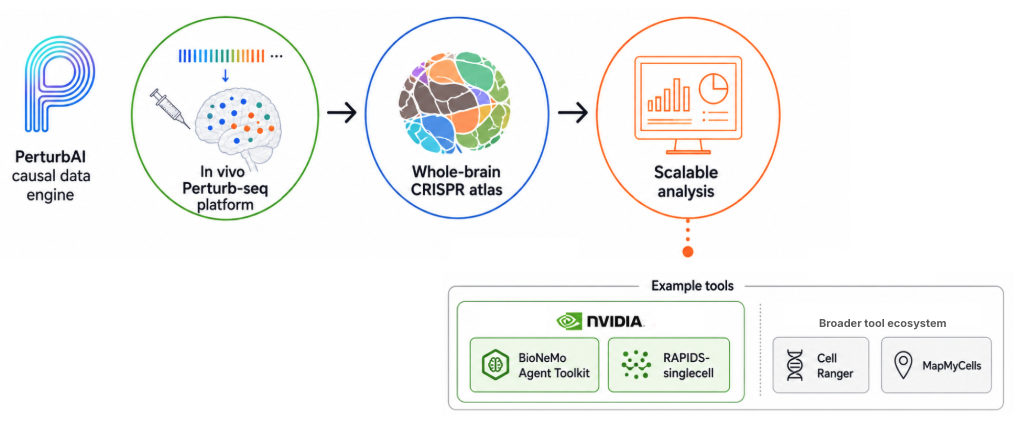
From in vivo perturb-seq to scalable analysis.
PerturbAI’s in vivo Perturb-seq platform generates causal perturbation data that powers the whole-brain CRISPR atlas. Atlas-scale datasets are then processed through scalable analysis workflows, with NVIDIA tools highlighted as one example within a broader tool ecosystem.
We’re excited by our collaboration with NVIDIA. Together, we are empowering researchers everywhere to explore and learn from PerturbAI’s public causal dataset.
And this represents only a small glimpse of what’s possible. At PerturbAI, our mission is to accelerate science and improve human health by building better biological models that can transform therapeutic development. We believe the future of therapeutic discovery lies in a rapid closed loop of data generation, model improvement, biological insight, and experimental validation.
If you’re interested in leveraging PerturbAI's causal biology engine to accelerate discovery and build the next generation of AI-enabled therapeutics, we’d love to hear from you.