
June 17, 2026
From whole brain CRISPR atlas to high confidence therapeutic targets
PerturbAI is a therapeutics company that combines organism-scale causal biology with proprietary AI to discover and develop better medicines.
Drug discovery often favors known targets because novel targets are risky and rarely translate to the clinic. PerturbAI changes this risk profile testing genetics-anchored therapeutic hypotheses directly in living organs. Rather than inferring target function from observational data, our platform interrogates thousands of perturbations simultaneously in tissue environments where disease emerges, and measures the perturbation effects at single-cell resolution. Because our engine is scalable and AI-native, we can rapidly convert causal biology into better target selection, sharper therapeutic hypotheses, and faster experimental decisions.
As a demonstration of our approach, we built the largest in vivo CRISPR atlas of the whole brain: a causal dataset with single-cell resolution that decodes how disease-linked genes act across brain regions, cell types, and circuits in living systems, and we made it open source for anyone to use. The atlas has already been downloaded more than 30,000 times across the biotech and tech industries and academia on Hugging Face since its release this March, reflecting a collective hunger for detailed causal maps of relevant in vivo biology. This data release is available through the PerturbAI Engine.
But massive scale creates a new bottleneck: interpretation. Which perturbations matter? Which cell types are affected? Which pathways converge? Which targets should be prioritized?
This is where PerturbAI is unique. Our proprietary AI stack is grounded in causal biological data generated directly in living systems. By combining PerturbAI-owned massive-scale, high quality perturbation maps, AI reasoning, and predictive models trained on causal biology, we can move from data to insight in days or weeks rather than months or even years, helping identify the mechanisms, targets, and therapeutic opportunities hidden within complex biological systems, and thus enabling more informed target selection and sharper therapeutic decision making.
PerturbAI’s AI stack: grounded in causal biology
PerturbAI’s proprietary AI stack has three core components:
AI agents coordinate experiments, tools, and data workflows to analyze perturbation-scale biology efficiently and reproducibly
Reasoning models interpret complex in vivo biology and translate causal signals into actionable drug discovery decisions
Predictive models learn from PerturbAI’s causal data to prioritize the targets and experiments most likely to matter
Together, our tools support the full workflow from experimental design and single-cell analysis to biological interpretation, target ranking, and next-experiment design. PerturbAI’s orchestration layer makes the system model-agnostic, allowing us to use the right model or tool for each task.
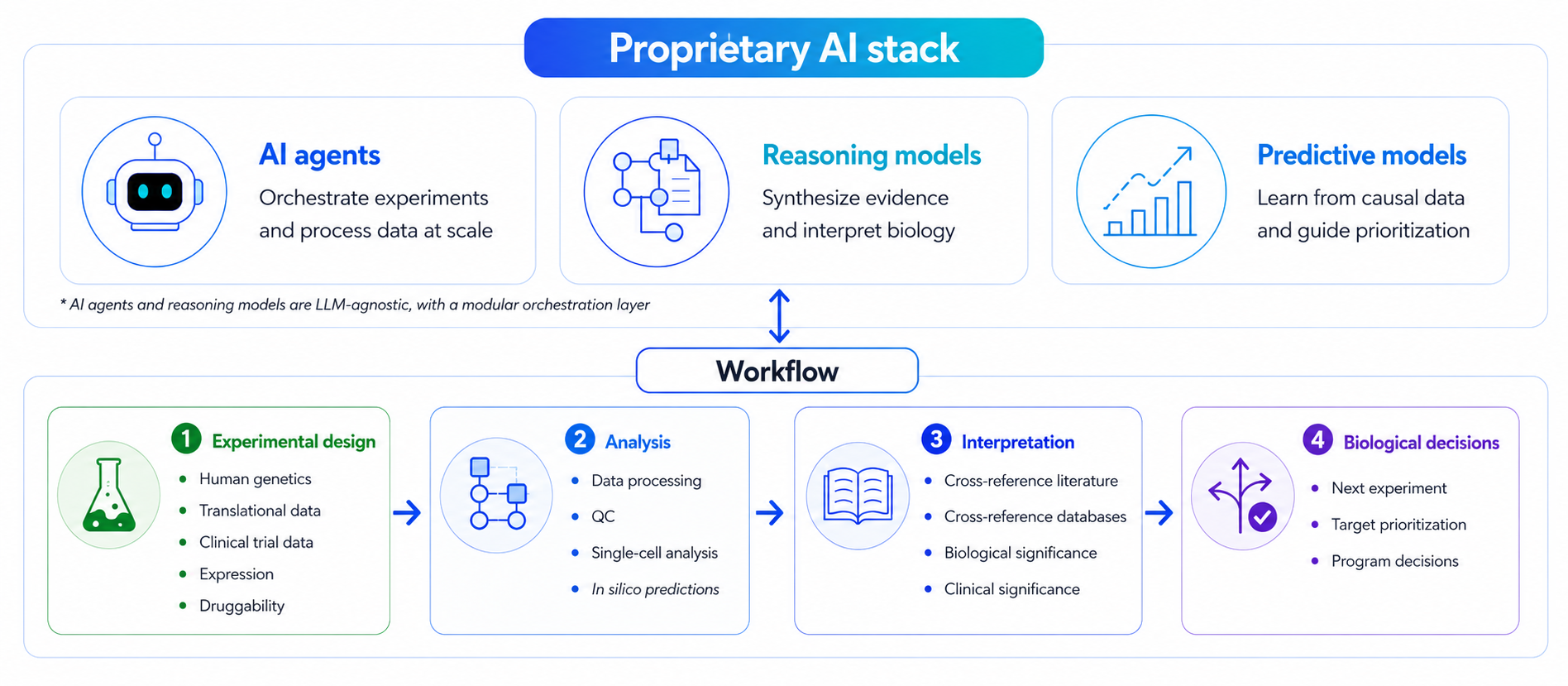
PerturbAI’s AI stack turns causal data into biological decisions
AI agents process and analyze data at scale, reasoning models synthesize evidence and interpret biology, and predictive models train on our massive causal datasets to guide prioritization.
Atlas-derived insight 1: NMDA receptor genes Grin2a and Grin2b reveal different intervention logic
One example comes from two related NMDA receptor genes: Grin2a and Grin2b.
At first glance, these genes appear closely related. And why not: after all, they are part of the same NMDA receptor family and are often discussed within the same biological pathway. But PerturbAI’s whole-brain in vivo perturbation maps reveal they behave very differently across cell types and brain regions.
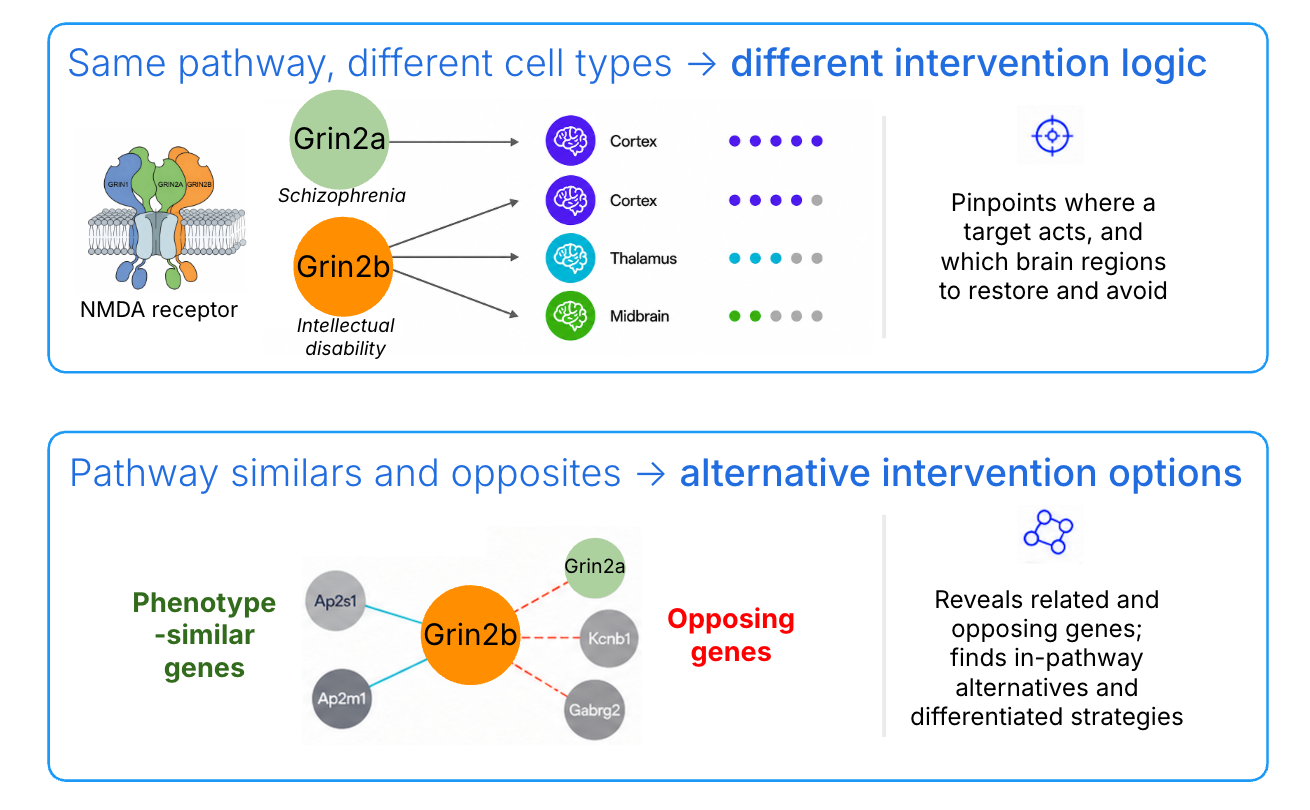
Grin2a and Grin2b reveal divergent NMDA receptor biology in vivo
PerturbAI’s proprietary perturbation maps show that related genes can produce distinct cell-type-specific effects, revealing different therapeutic logic.
To interpret this biology, PerturbAI built multiple agents:
A biological agent to analyze cell-type- and perturbation-specific effects
A clinical agent to connect perturbation effects to disease context and therapeutic strategy
A grader agent to rank perturbations based on biological significance, clinical relevance, and follow-up potential
Three insights emerged.
First, Grin2a function is enriched in cortical neurons and co-clusters with genes such as Gabrg2, suggesting a more specific cortical activity pattern.
Second, Grin2b perturbation affects a broader set of cortical and subcortical cell populations and clusters with AP2-related biology, linking it to endocytosis and receptor trafficking.
Third, Grin2a and Grin2b are not interchangeable. Shared differentially expressed genes between the two perturbations are anti-correlated: genes involved in synaptic plasticity and neuronal activity move in opposite directions.
This has direct therapeutic values. The PerturbAI functional map helps define where a therapy should act, which cell types to restore, and which regions or cell populations to avoid. It also reveals pathway-similar and pathway-opposite genes that may offer alternative therapeutic strategies.
Atlas-derived insight 2: Neurodegeneration genes converge on shared transport and endolysosomal biology
A second example from the PerturbAI healthy whole-brain atlas comes from neurodegeneration-linked genes.
Many neurodegenerative diseases look different clinically, but at the cellular level they often converge on shared maintenance pathways, including axonal transport, endolysosomal trafficking, proteostasis, and synaptic maintenance.
PerturbAI’s whole-brain atlas allows these pathways to be studied in one unified in vivo framework. For example, Htt and Dctn1 map to axonal transport biology, while Vps35, Vps41, and Rab7 map to endolysosomal and retromer-associated trafficking.
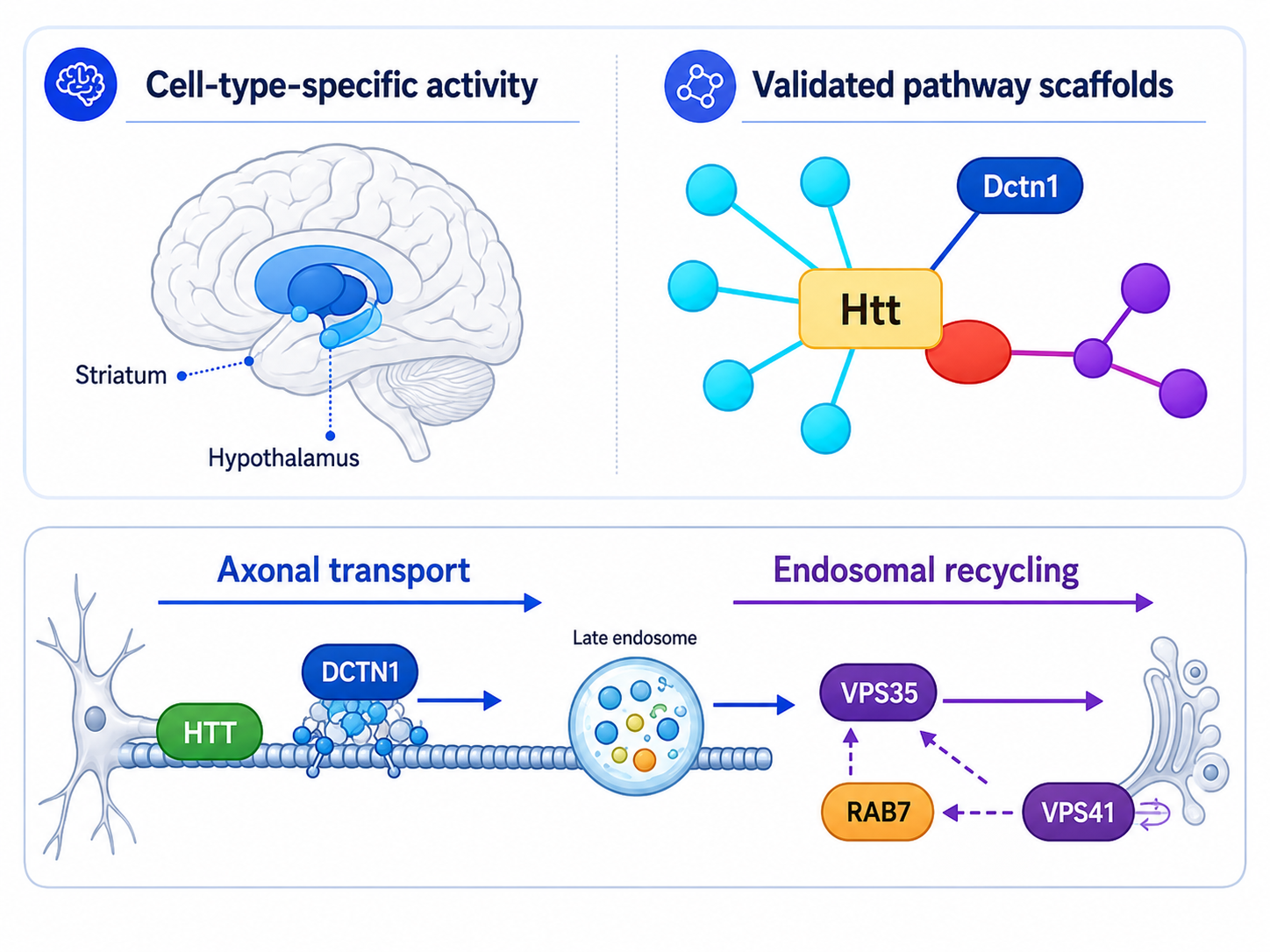
Neurodegeneration-linked genes converge on transport and endolysosomal pathways
Causal in vivo maps reveal shared pathway structure across disease-linked genes, helping define biological scaffolds for follow-up.
This moves beyond single-gene observations. The atlas reveals how different disease-linked genes organize into shared pathway scaffolds. PerturbAI’s agents can then synthesize perturbation effects, pathway relationships, literature, and disease evidence to propose mechanisms and prioritize the next experiments and targets.
From data to therapeutic decisions
Our ultimate goal is not just better analysis for analysis’ sake. We’re using our deep in vivo insights to drive better informed biological decisions for therapeutic development.
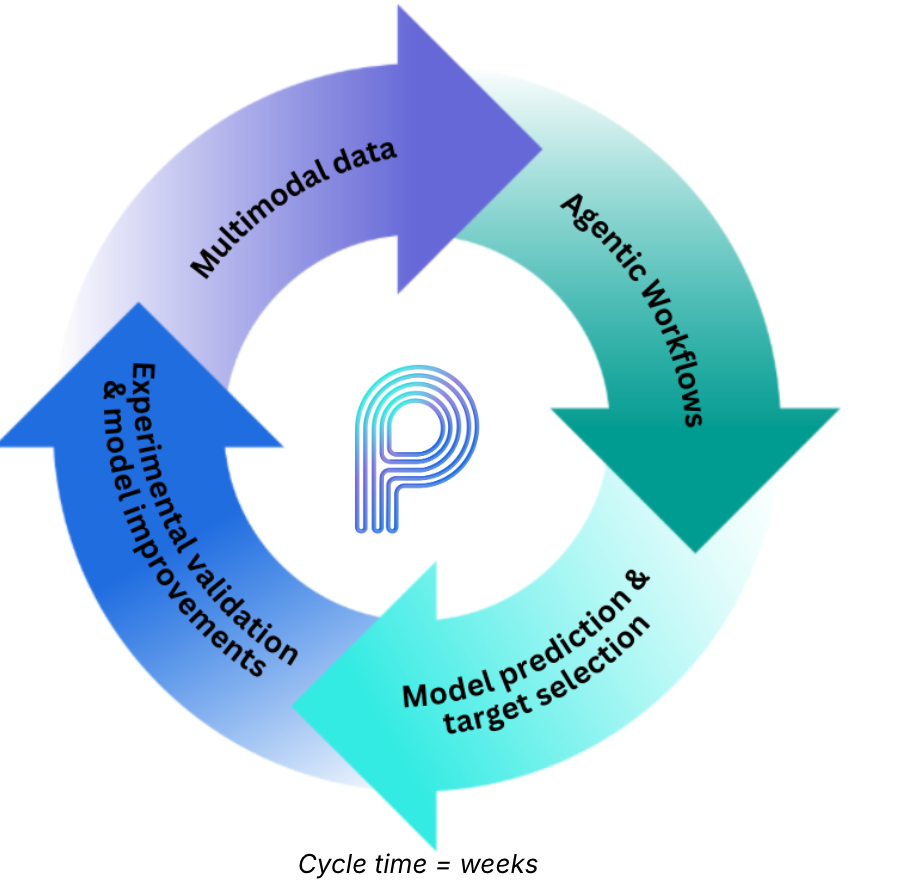
Drug discovery loop: go from data to insights in days/weeks.
Perturb AI agents translate perturbation signals into structured summaries, biological rationale, and next-step, ranked target discovery recommendations.
At PerturbAI, we believe the future of drug discovery leverages an accelerated closed loop: generate causal data in living systems, use AI agents to interpret the biology, prioritize targets and therapeutic hypotheses, and design the next experiment.
By combining proprietary in vivo perturbation maps, AI reasoning, and predictive models trained on causal biology, PerturbAI has created an unprecedented system that moves from data to insight in days or weeks, making more informed target and therapeutic decisions. Less than a year after our pre-seed financing, we’ve already generated and shared the first healthy whole-brain CRISPR atlas and launched disease-mapping efforts in both the brain and liver. These datasets already reveal new biological mechanisms and produced novel therapeutic targets showing early promise in metabolic and rare diseases.
And we’re just getting started. We believe this is only the beginning of what organism-scale causal genomics can enable. If you’re interested in being a part of this new chapter of therapeutic discovery, we’d be glad to connect.